
The JUICE Mission: Exploring Jupiter and Its Icy Moons
Europe’s journey towards Jupiter is already under way
Jupiter and its moons have always stirred my imagination. What would a storm inside the Great Red Spot feel like? What would it feel like to fall through Jupiter’s atmosphere? How would you know where the atmosphere ends and the planet begins if the planet itself is also made of gas?
And its moons. The Galilean moons, those beauties. They look so … alive. Mysterious. When I first saw pictures of them, it seemed almost impossible that there would not be … something there.
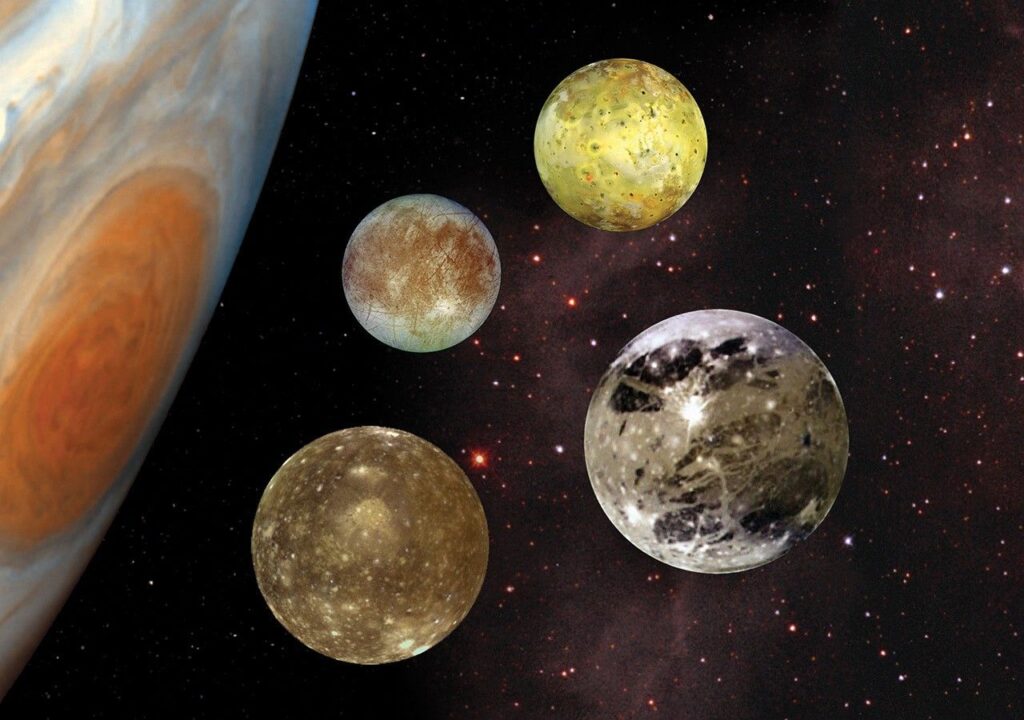
From top to bottom: Io, Europa, Ganymede and Callisto.
Photo: NASA
The volcanic activity on Io, the unusual channels on the surface of Europa, the craters and strange landscapes on Callisto …
And then I discovered that the European Space Agency’s JUICE mission is travelling towards this world right now.
JUICE stands for Jupiter Icy Moons Explorer. The spacecraft belongs to the European Space Agency (ESA) and was launched in 2023.
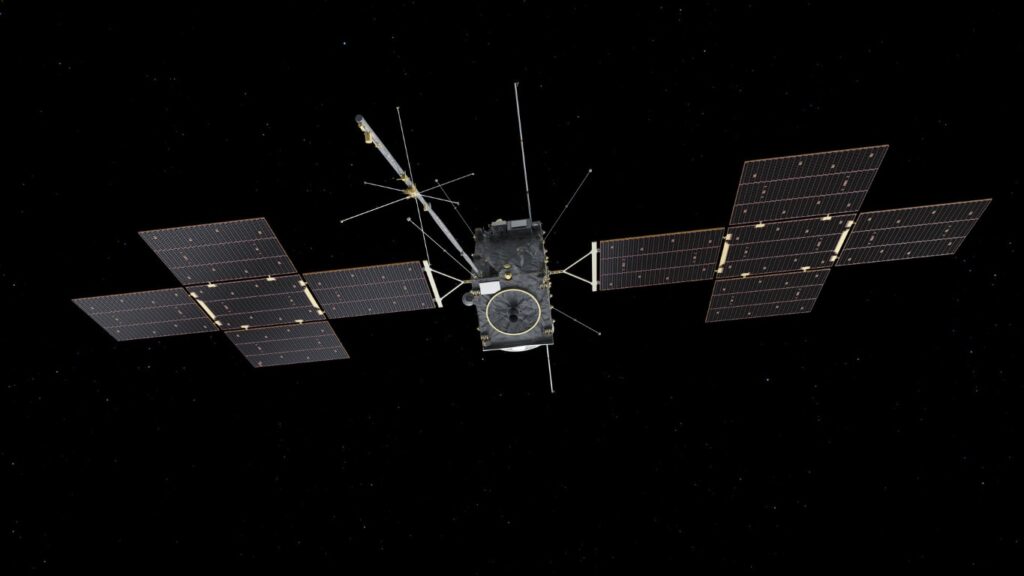
Photo: ESA
What JUICE May Discover Beneath the Ice
The JUICE mission will explore Jupiter and three of Jupiter’s icy moons: Europa, Ganymede and Callisto. Beneath their frozen surfaces, there are most likely enormous subsurface oceans of liquid water.
With the help of the JUICE spacecraft, scientists want to discover:
- how deep these oceans are,
- what their chemical composition is,
- whether they contain conditions suitable for the development or existence of life,
- and how these moons formed and continue to develop.
In other words, they want to understand the habitability of Jupiter’s icy moons—whether these distant worlds could offer conditions in which life might exist.
Where there is liquid water, there is also the possibility of chemical processes that could allow life, as we know it on Earth, to develop.
One special feature of the JUICE mission is that, towards its end, the spacecraft will become the first in history to orbit a moon of another planet. JUICE will orbit Ganymede, the largest moon in the Solar System. There, it will spend several months taking detailed measurements of the surface, internal structure and magnetic field.
Besides Jupiter’s icy moons, JUICE will also study:
- Jupiter’s atmosphere,
- its extremely powerful magnetic field,
- its ring system,
- and the influence that Jupiter and its moons have on one another.
Jupiter is not interesting only because of the planet itself. As the largest planet in the Solar System, it probably played an important role in shaping the Solar System as we know it today.
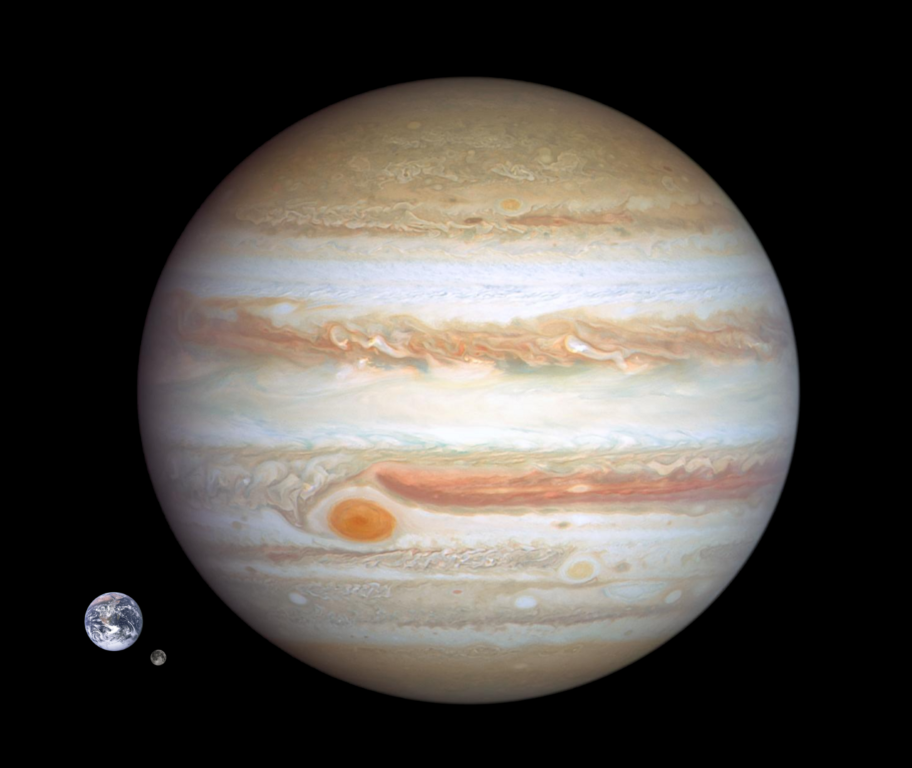
Photo: Wikipedia
Scientists hope the JUICE mission will help answer questions such as:
- What are the ocean worlds around Jupiter like?
- Could there be—or could there once have been—life in the Jupiter system?
- How has Jupiter’s complex environment shaped its moons, and how have the moons shaped it in return?
- How does a typical gas giant form, and how does it work?
The Long Way to Jupiter
How Gravity Helps JUICE Travel Through Space
A video showing the JUICE spacecraft’s journey towards the Jupiter made me want to learn more about the project. At first, the solution seems simple. You point a rocket towards Jupiter and wait. But physics tells us something very different.
A direct journey to Jupiter would first require far more fuel than the spacecraft could carry. Then, when the spacecraft reached Jupiter, it would need another enormous amount of fuel to slow down. Then, when the spacecraft reached Jupiter, it would need another enormous amount of fuel to slow down. Otherwise, it would simply shoot past the planet.
Because of this, scientists planned a much slower JUICE flight path, lasting a little over seven years and using gravity assists from planets along the way.
Source: SciNews, YouTube
Watch the video and think …
- What kinds of mathematical models are needed to calculate the exact movements of the planets?
- How do scientists match those movements with the JUICE spacecraft’s journey?
- How do they make sure that each close approach to a planet gives the spacecraft exactly the right increase or decrease in speed, allowing it to continue along its planned path and enter Jupiter’s orbit after more than seven years?
There is so much beauty hidden in science.
To briefly summarise the JUICE mission’s journey:
The spacecraft was launched in April 2023. JUICE will need a little less than eight years to reach Jupiter. During this time, it has already performed, or will perform, gravity-assist flybys of Venus, Earth and the Moon to increase its speed. About six months before reaching Jupiter, JUICE will begin making scientific observations as it approaches the planet.
The spacecraft will spend about four years exploring the Jupiter system. During this time, it will orbit Jupiter and fly past Europa, Ganymede and Callisto before finally entering orbit around Ganymede.
JUICE is the first spacecraft ever to perform a special lunar-Earth gravity-assist manoeuvre, in which it first flew past the Moon and then, immediately afterwards, past Earth. By doing this, it saved an enormous amount of fuel.

Photo: Wikipedia
Even space seems to want to show us that the shortest route is not always the fastest or the most efficient one.
Where the JUICE Journey Began
And here is an interesting fact. Although JUICE is a European Space Agency mission, it was not launched from Europe. The spacecraft was launched from French Guiana, an overseas department of France.
The location was not chosen by accident. The launch site lies close to the equator, at about five degrees north. Why is that important?
The surface of the Earth moves much faster at the equator than it does at the poles. The closer a launch site is to the equator, the more “free” speed a rocket receives during launch.
In other words, the rocket already carries some of the speed created by the Earth’s rotation. This means it needs less fuel and can carry heavier loads.
This is also one of the reasons why many major launch sites are located as close to the equator as possible.
How Do You Explore a World from So Far Away?
The JUICE Scientific Instruments
When the JUICE spacecraft reaches Jupiter, it will be several hundred million kilometres away from Earth. It is equipped with ten scientific instruments that will take measurements and photographs.
The JUICE spacecraft will send all this data towards Earth in the form of radio waves. Here, the signals will be received by the European Space Agency’s enormous antennas. Computers will then turn them into photographs, measurements and other scientific data.
Depending on the distance between Earth and Jupiter, a signal takes between 35 and 55 minutes to reach Earth. This means that communication can never happen live.
When scientists send a command to the JUICE spacecraft, they have to wait approximately an hour and a half for a reply.
The names of JUICE’s scientific instruments sound quite complicated, but their tasks can be explained quite simply. Some instruments will observe. Others will look beneath the surface. A third group will measure things that humans cannot see or consciously sense.
Instruments that Observe
These instruments detect different kinds of light, from visible light to ultraviolet and infrared light. This allows scientists to observe the surfaces of the moons, study the clouds in Jupiter’s atmosphere and discover which substances they are made of.
- The optical camera on the JUICE spacecraft will take detailed photographs of Jupiter and its moons.
- UVS will detect ultraviolet light produced by gases in the atmosphere and help scientists determine its composition.
- MAJIS will analyse light reflected from surfaces and clouds. Because every substance reflects light in a slightly different way, scientists will be able to determine whether they are observing ice, different minerals or other compounds.
- SWI will measure temperatures and radiation in the Jupiter system. It will also help scientists study the atmosphere and its movement.
- GALA will use laser pulses to measure differences in height across the surfaces of Jupiter’s icy moons with great precision. It will then be possible to create 3D maps of these moons.
Instruments that Look Beneath the Surface
The surfaces of Jupiter’s icy moons are already extremely interesting. But the question of what lies beneath their frozen covers is even more exciting.
- For this reason, the spacecraft also carries RIME—the Radar for Icy Moons Exploration. This instrument sends radio waves through the ice. Some of these waves reflect from different layers below the surface and return to the spacecraft. By studying these reflections, scientists will try to discover how thick the ice is and whether subsurface oceans of liquid water really exist beneath it.
Instruments that Measure What We Cannot See
A large part of Jupiter’s world, just like much of the world around us, is completely invisible to our eyes. The JUICE mission will therefore also measure magnetic fields, charged particles, plasma and gravity.
- J-MAG will measure the magnetic fields of Jupiter and its moons. With the help of this data, scientists will study how magnetic fields influence the surrounding environment and the internal oceans of Jupiter’s icy moons.
- These measurements will help them understand how Jupiter’s magnetic field interacts with the magnetic fields of its moons and whether liquid oceans exist beneath their surfaces.
- PEP will study charged particles around the JUICE spacecraft. This will provide information about how these particles travel through Jupiter’s magnetic field.
- RPWI will observe radio waves and plasma. It will help scientists understand how plasma and electromagnetic waves behave inside Jupiter’s magnetosphere.
- 3GM uses radio signals travelling between Earth and the JUICE spacecraft. The spacecraft sends radio signals towards Earth. As these signals travel past Jupiter or one of its moons, they change slightly because of gravity and the atmosphere. By studying these tiny changes, scientists can learn about the internal structure and gravitational fields of these bodies, as well as the properties of their atmospheres.
The Questions Waiting in 2031
Now, all we have to do is wait for the JUICE spacecraft to reach Jupiter. This will happen in 2031, after a journey of almost eight years through the Solar System.
Perhaps the JUICE mission will then provide answers to some of the questions above.
But I am certain that many new questions will also appear. And that is one of the most beautiful parts of science.
Authorship and use of AI
This article is based on my own research, thinking, and editorial work. I used artificial intelligence as a support tool during the writing process, mainly for structuring the text, improving clarity, and, where relevant, translating it into English.
All key decisions, interpretations, and the final version of the text are my own.
FURTHER READING:
– European Space Agency, ESA: JUICE mission
– Wikipedia: JUICE—Jupiter Icy Moons Explorer
– NASA: Jupiter
– NASA: Jupiter’s Moons