
Geopolitics 101
Politics never really interested me very much. Ever since I started living on my own, I have been one of those people who do not have a TV at home and do not follow daily news. I believed it made sense to stay apolitical.
Over time, however – with age and more life experience – I learned that politics has a very concrete impact on our everyday lives.
Once, quite by accident and long after I had finished my formal education, I heard the term geopolitics for the first time. Wait a moment – geo as in geography, connected with politics? Hmm … that caught my attention.
And wow. A whole new world opened up.
Suddenly, many questions like “why does the world work the way it does?” received surprisingly simple and logical answers. And even though I still believe that no soup is eaten as hot as it is cooked (which is why I still avoid following politics on a daily basis), I know I wish I had heard about geopolitics much earlier.
This article was written with my students in mind. This year, I decided to dedicate a few lessons toward the end of the school year to geopolitics.
How to understand geopolitics?
Geography is a framework states cannot change
Geopolitics starts from a simple fact: states do not operate in empty space.
Every country is located in a specific physical space that it did not choose and cannot fundamentally change. It has a certain location, certain neighbors, access to the sea or none at all, natural barriers or open corridors. This spatial framework defines what options a country actually has.
That is why politics cannot be understood only through the decisions of individual leaders or through ideology. The first step is to ask what a country can realistically do given its geography. Only then comes the question of what it wants. Political wishes and programs can change quickly; geography mostly remains the same.
Mountains cannot be moved.
Straits cannot be widened.
You cannot create a sea where there is none.

Image source: Wikipedia, World map
Countries without access to the sea are always more dependent on others for trade, supply, and global connections. Countries located on open plains without natural protection have historically been more exposed to invasions and pressure. Their security is therefore not measured only by the length of their borders, but by the depth of space they can lose before they are seriously threatened.
On the other hand, countries that control narrow passages, straits, or key transport routes often have far more influence than their size or economic power would suggest. Their position gives them leverage.
Why political patterns repeat
When we look at geopolitics this way, many events become easier to understand. Decisions that seem aggressive or irrational at first glance often follow the logic of space and long-term security interests. This does not mean these decisions are justified or acceptable. It means they are not random. Geopolitics does not judge; it helps explain why states behave the way they do.
It is also important to distinguish between short-term and long-term thinking. Politicians think in election cycles; states think in decades or even centuries. This is why certain patterns in world politics repeat. Not because history simply goes in circles, but because basic geographic conditions do not change.
Where important trade routes meet, tensions arise.
Where there are no natural borders, security buffers and struggles for influence keep appearing.
Where there is only one key route for energy or goods, vulnerability emerges that politics finds hard to eliminate.
Political language and real state interests
To understand geopolitics, it is crucial to separate political narratives from actual interests. States rarely explain their actions in terms of geography or strategic limits. More often they speak about values, security, historical rights, or protection of people. This language is not necessarily false, but it does not tell the whole story.
If we want to understand decisions, we need to ask what it would mean to lose access to the sea, energy, trade routes, or strategic depth. That is where the real reasons usually lie.
Geopolitics also helps explain why stability in international relations is often imperfect. The world often maintains arrangements that are not fair or democratic because their collapse would create even greater risk and uncertainty.
Stability requires constant compromise.
Chaos is usually more expensive.
That is why some conflicts are not resolved but remain frozen for long periods.
Geopolitics does not offer simple answers and does not predict the future. It does, however, provide a framework that allows us to read events more rationally and less in black-and-white terms. It helps us see constraints, recognize leverage, and understand why certain patterns in global politics keep returning.
Global transport is concentrated in a few key points
In geopolitics, there are places where a large share of global transport is concentrated in a very small area. These are straits, canals, and natural passages through which key maritime and energy routes pass. Such points are known as choke points.

Image source: www.visualcapitalist.com
Their importance does not come from the size or power of the state that controls them, but from the fact that without them the global system does not function in the same way.
Canals and straits act like valves in the global circulation system. When they are open, traffic flows relatively smoothly. When they close or become risky, the effects quickly spread far beyond the region itself.
Delays, higher energy and goods prices, and supply disruptions are transferred very quickly into economies and everyday life in a globally connected world.
It is important to understand that the value of a choke point does not depend on whether a physical alternative exists, but on whether that alternative is usable in practice. If ships can technically sail along another route, but this means weeks of delay, significantly higher costs, or overload of other routes, then the world does not really have a choice. In such cases, we speak of a single functional route, even if detours exist on the map.
From a geopolitical perspective, it therefore makes sense to distinguish between choke points without which the system cannot function normally and those where closure causes problems, but not collapse. In the first case, even a small disruption has major consequences. In the second, the system adapts, although with certain losses.
This difference explains why the world treats some areas with extreme caution and others far less so.
Why choke points are geopolitical leverage
A state that controls such a point does not need a large army or a strong economy to have influence. It is enough to slow down traffic, restrict it, or make it uncertain. This gives leverage over much larger and more powerful actors.
Power in geopolitics is not always about force; it is often about position.
This is why these locations are rarely treated as ordinary national territory. They often involve special security arrangements, international cooperation, and informal agreements.
Stability becomes a shared interest, even if this means working with regimes that are otherwise politically problematic. In such cases, system logic dominates: smooth flow is prioritized over value-based concerns.
Canals as artificial but irreplaceable choke points
Canals play a special role because they are artificial yet irreplaceable connections. They were built through massive investment, often in the colonial era, to shorten routes and increase efficiency in global trade.
Once they exist, global transport quickly becomes dependent on them.
The entire system optimizes around them: shipping fleets, insurance, logistics, and prices all assume these passages remain open. When disruption occurs, their true importance becomes visible. Even temporary closure of a single canal or strait can trigger a chain reaction: ships stop, prices rise, supply chains become strained.
At that point it becomes clear that these passages are not just transport routes, but strategic points on which the global system depends.
To understand geopolitics, we therefore must look not only at states, but also at the spaces between them. The world map is made not only of territories, but also of routes through which energy, goods, and resources move. Where these routes narrow, vulnerability – and geopolitical power – is greatest.
Choke points in practice – Suez Canal, Strait of Hormuz, Malacca Strait
When we talk about choke points, we are not talking about exceptions, but constants of the global system. World trade and energy supply are not evenly distributed; they are concentrated in a few key locations. These locations determine where the system is most efficient and most vulnerable.
The Suez Canal, the Strait of Hormuz, and the Malacca Strait are three different examples of the same logic: a small space with a disproportionate impact on the world.
Suez Canal: a choke point between Europe and Asia
Today, the Suez Canal is one of the clearest examples of this dependency. It connects Europe and Asia and allows global trade to move quickly and relatively cheaply. The global system is organized as if this route will always be available.
When traffic through the canal stopped for several days in 2021, it was not a political crisis but a technical accident. Yet the effect was the same: ships were stuck, prices increased, and supply chains were disrupted. The event showed that the system has no real alternative. Sailing around Africa is possible, but it means weeks of delay and much higher costs. Functionally, the Suez Canal is irreplaceable.
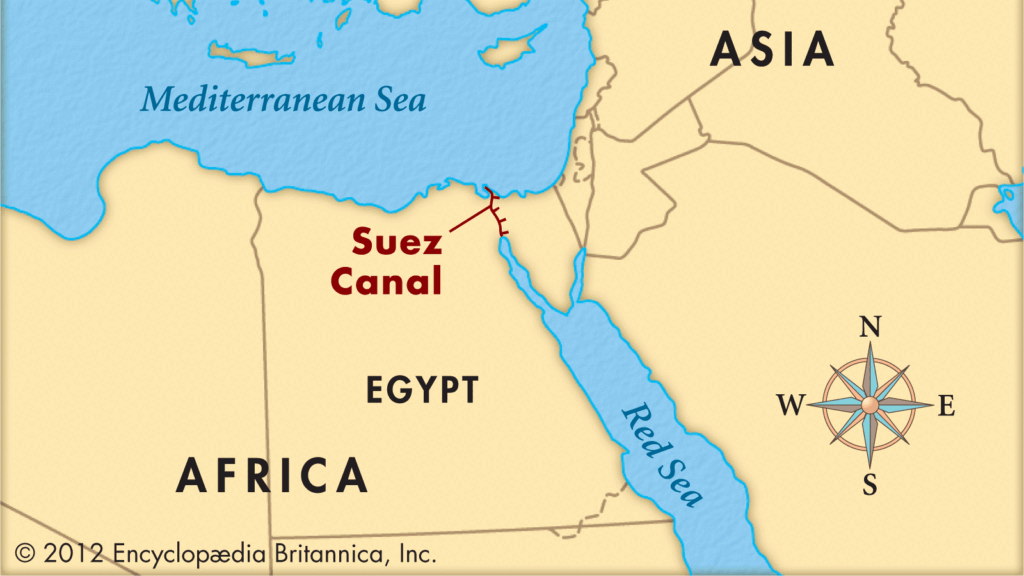
Image source: kids.britannica.com
This dependency is not new. Since its opening in the 19th century, its importance has been primarily geopolitical. It gave European powers faster access to Asian colonies and markets. In the 20th century, it became a source of direct political conflict, showing that control of a transport point means more than control of infrastructure alone.
Today Egypt has full control over the canal, and its geopolitical weight largely comes from this fact. The world therefore has a pragmatic relationship with Egypt: the stability of the canal matters more than internal political issues.

Image source: cnbc.com

Image source: science.nasa.gov
Strait of Hormuz: the world’s energy choke point
A similar logic, with different consequences, appears in the Strait of Hormuz. Unlike the Suez Canal, it is a natural strait, not an artificial one. Around 20% of the world’s oil and gas supply passes through it. Here, vulnerability is tied not only to trade, but to energy that powers modern economies.
If traffic through the strait slows or stops, the effects are immediate: rising prices and market uncertainty.
Historically, the strait became crucial once oil became the central global energy source. Since then, stability in the Persian Gulf has been directly linked to global stability. A key feature of this choke point is that Iran does not need full control or military dominance to have influence. It only needs to create risk.
Because the strait is narrow and heavily used, even small disruptions have large effects. That is why the world often avoids direct confrontation with Iran. Not because its policies are supported, but because the system cannot afford a closure of the Strait of Hormuz.
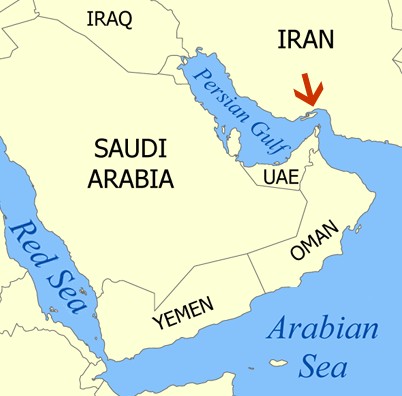
Image source: Wikipedia
Malacca Strait: China’s maritime vulnerability
The third example, the Malacca Strait, shows the same logic from the perspective of a major power that is itself vulnerable. Most of China’s energy imports and a large share of its exports pass through this strait. It is not under Chinese control, but lies between Southeast Asian states, with Singapore playing a key role due to its location and infrastructure.
This means that despite its size and power, China depends heavily on a single maritime route that could be threatened in a crisis.
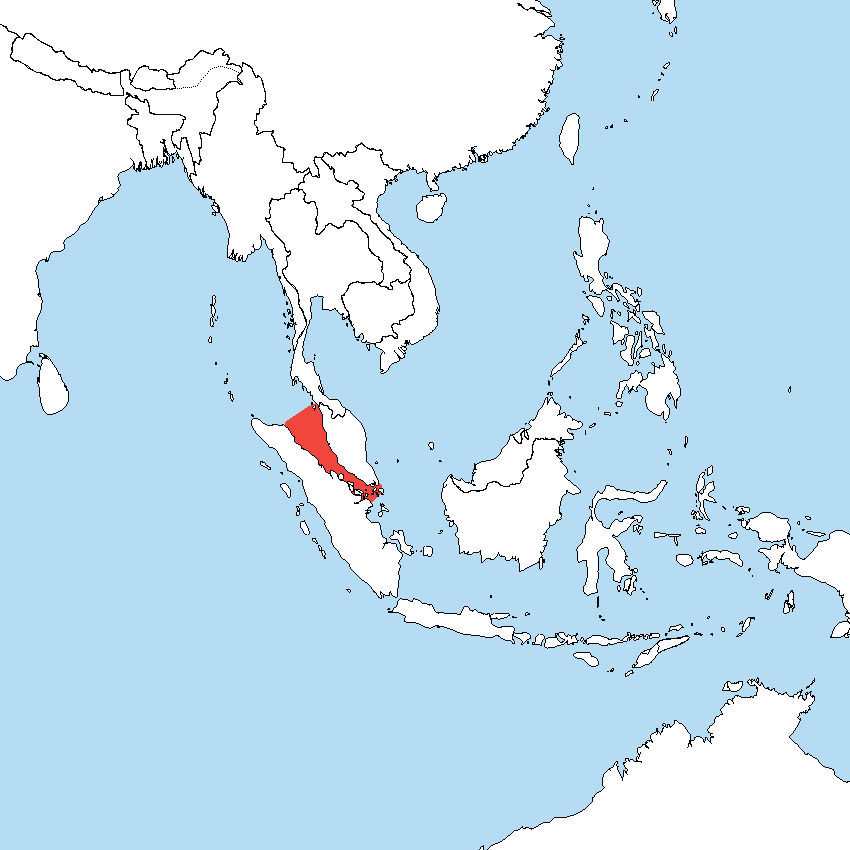
Image source: Wikipedia
This vulnerability matters especially because it does not fit China’s historical experience. For most of its history, China was a land-based civilization. Stability depended on control of internal space, fertile plains, major rivers, and land routes. Threats came from land, not the sea.
Today, China is in a very different position. Its economy is deeply integrated into global trade and dependent on maritime routes for energy and raw materials. Yet China does not control these routes. It depends on seas where other states play key roles and where the dominant influence is held by the U.S. Navy. This creates strategic tension between China’s economic power and its security vulnerability.
China does not respond with direct confrontation or rapid military solutions. Instead, it acts slowly and cautiously. It invests in land corridors, ports, and alternative routes to reduce dependence on a single maritime point and spread risk. These alternatives are less efficient and often very expensive, but in geopolitics efficiency is not the only measure. Reliability in a crisis matters more.
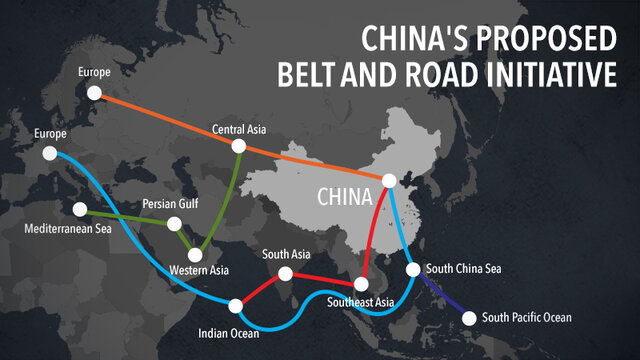
Image source: cadtm.org
This gap between China’s historical land-based logic and its modern maritime dependence helps explain its foreign policy behavior. It often appears cautious yet systematic. This is not a lack of ambition, but adaptation to a space China does not fully control.
Taken together, these three cases show that choke points are not geographical curiosities, but structural elements of global politics. States that control them gain influence beyond their size. States that depend on them must act cautiously and think long term. The global system can optimize around these points, but it cannot avoid them.
Choke points are therefore not a problem that can be solved once and for all. They are a constant feature of geopolitics. That is why tensions, crises, and careful compromises keep appearing in the same places – not because of accidents or individual mistakes, but because space defines the limits of what is possible.
The Balkans as a space of constant tension
The Balkans are often described as an unstable region, but this description misses the point. The problem of the Balkans is not the people or individual political decisions, but geography. It is a space where major empires have met and overlapped throughout history, functioning not as a stable center, but as a transition zone between larger powers.
Already in antiquity, it marked the divide between the western and eastern parts of the Roman Empire. Later, it became the meeting point of the Byzantine and Western European worlds. In the early modern period, it was the long-term contact zone between the Habsburg Monarchy and the Ottoman Empire, dividing the region politically, religiously, and culturally.
Borders in such a space were rarely formed from within. They were often the result of external military balances and diplomatic agreements. The population was ethnically, linguistically, and religiously mixed, while political allegiance shifted with changes in power. When one empire withdrew, a vacuum appeared, almost inevitably leading to new tensions.
This pattern did not end with the collapse of empires. In the 20th century, the Balkans again became a zone of overlapping interests – after the collapse of the Ottoman Empire, after World War I with the breakup of Austria-Hungary, and later during the Cold War, when the region lay between the Eastern and Western blocs.
The breakup of Yugoslavia in the 1990s was not a historical exception, but a continuation of the same spatial logic. The state collapsed when the Cold War ended and Yugoslavia lost its role as a buffer between East and West.
The Balkans are not chronically unstable because of their past, but because of their location. Stability in this region has always depended on external balance. Today, that balance is maintained by outside actors. The European Union ties the region through economic links, financial support, and the promise of future membership. NATO prevents escalation through military presence and security guarantees. The United States acts as the ultimate security backstop.
Stability is therefore not the result of resolved issues, but of constant external management of the balance of power.
Russia and the East European Plain: the geography of fear of invasion
If we want to understand Russian geopolitics, we must first understand the space in which Russia is located. The East European Plain is a wide, open lowland that stretches from Europe toward Russia and further into the interior of Eurasia. It is a space with very few natural obstacles. There are no high mountain ranges and no clear natural borders that could stop or slow the movement of military forces. This openness is a key characteristic that has shaped Russian security thinking throughout history.
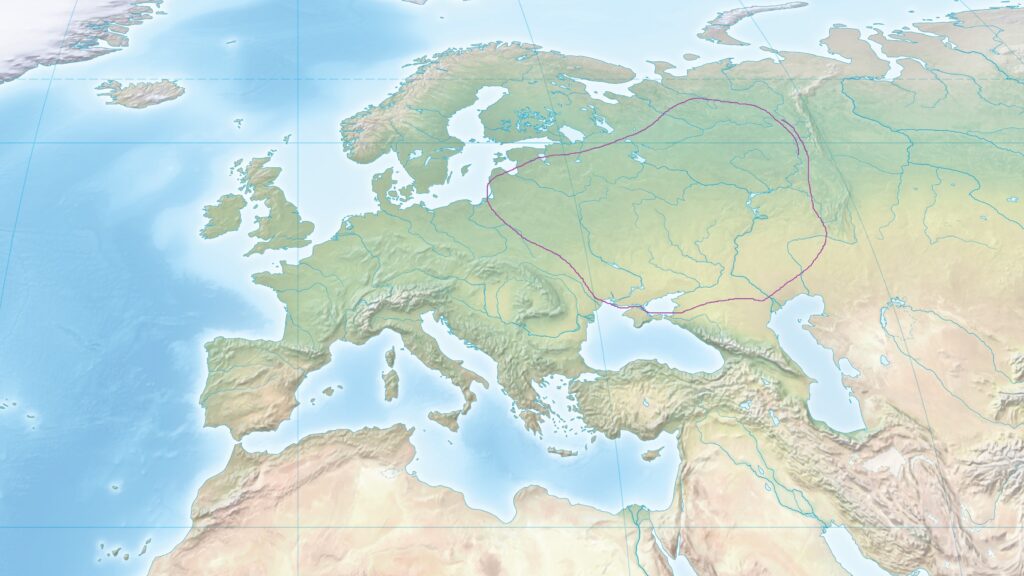
Image source:Wikipedia
In such a space, borders are not solid defensive lines, but administrative divisions. Defense is therefore not built at the border itself, but in the depth of space. For Russia, security has never meant only control over its own territory, but also control over neighboring areas that can function as buffers (buffer states). The more space there is between a potential adversary and Russia’s core regions, the more time and room for maneuver the state has in the event of conflict.
This logic is not ideological, but historically conditioned. Russia has repeatedly been exposed to invasions from the west. Napoleon’s army and later Nazi Germany both took advantage of the openness of the plain and penetrated deep into Russian territory. In both cases, spatial depth was the key factor that enabled Russia to survive. Retreat, exhaustion of the opponent, and long supply lines compensated for the lack of natural barriers.
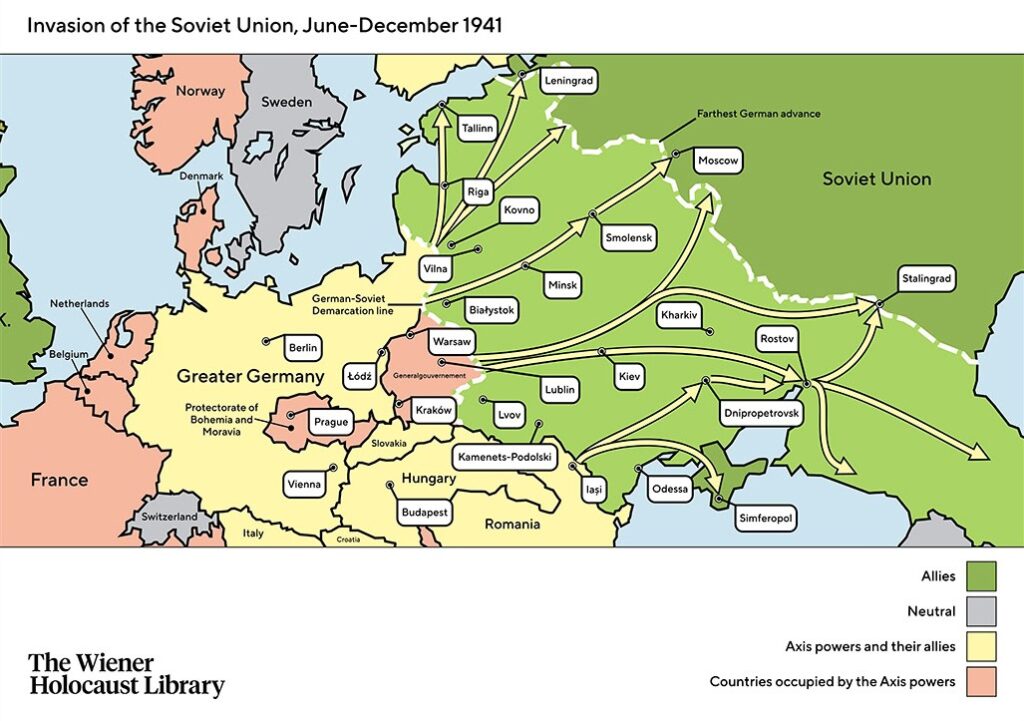
Image source: www.theholocaustexplained.org
As a result, a belief became deeply rooted in Russian strategic thinking that security must be ensured in advance and far away from the country’s core centers. When Russia loses influence over border regions, it does not interpret this merely as a political defeat, but as a direct security risk. A change in the orientation of a neighboring state is not read, within this logic, as an internal decision of another nation, but as a shift of the security line toward Russia’s core areas.
This way of thinking has persisted regardless of the political system. Tsarist Russia, the Soviet Union, and today’s Russian Federation were ideologically very different, yet their basic security logic has remained remarkably similar. Symbols and language changed, but space did not. Geography remained the same, and with it the fundamental fear of exposure.
In the modern world, this logic often clashes with a different understanding of sovereignty. For Western states, a border is primarily a legal line that defines where the authority of one state ends and another begins. For Russia, however, a border in itself does not guarantee security if there is not enough space behind it. This is why areas such as Ukraine, Belarus, and the broader Eastern European region are, in Russian perception, more than just neighboring states. They are part of the security architecture.
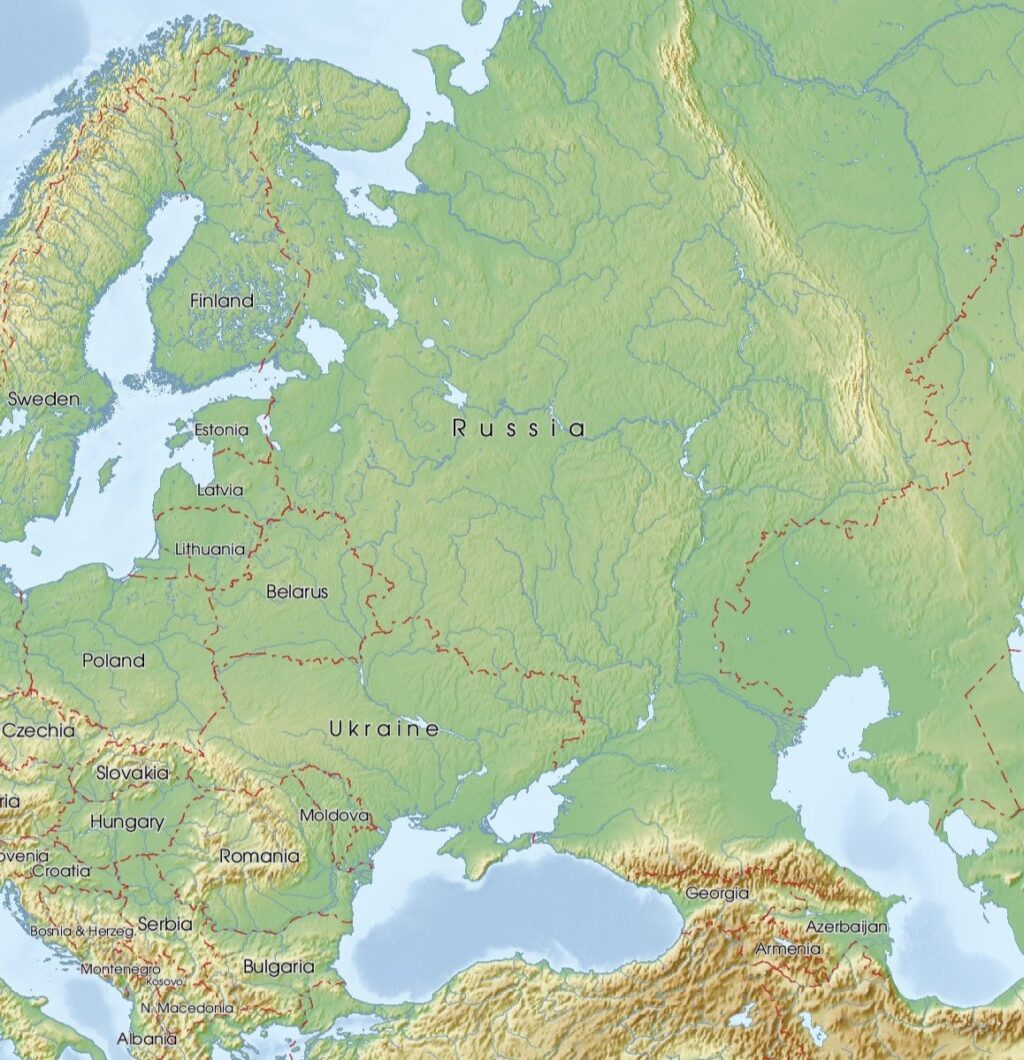
Image source: mapswire.com
This does not mean that conflicts are inevitable or justified. It does mean that without understanding space, they cannot be explained. When political orientations or security alignments change in Eastern Europe, Russia perceives this as a shrinking of its own security space. In an open plain without natural borders, security is not measured in kilometers of border, but in depth of influence.
The East European Plain is therefore not merely a geographic term, but a fundamental framework of Russian geopolitics. As long as this space remains open and without natural barriers, Russia will seek its security beyond its formal borders. This helps explain why tensions in this part of Europe keep returning and why this space repeatedly finds itself at the center of global politics.
The European Union as a non-unified geopolitical power
If we want to understand why Europe as a whole struggles to act as a unified geopolitical actor, we must first look at its physical space. Europe is not a single, uniform continent, but a mosaic of very different geographic regions. Mountains, peninsulas, seas, and rivers have historically separated communities, created natural boundaries, and enabled the development of many political centers. This fragmentation is one of the key reasons why so many states developed in Europe, each with its own interests, security concerns, and historical experiences.
Unlike large land-based powers, Europe does not have a single central geopolitical axis. Northern Europe looks toward the Atlantic and the Arctic, the south toward the Mediterranean, the east toward the landmass of Eurasia, and the west toward the transatlantic world. This means that states do not perceive the same threats. What is a security issue for some is a distant problem for others. This difference in the perception of space is directly translated into politics.
The European Union was created as a project of cooperation with primarily economic and political goals: to prevent new conflicts within Europe. In this, it has been very successful. However, the EU was not created as a classical geopolitical actor with a shared security logic, unified military power, and clearly defined external interests. Member states retained control over their foreign and security policies because their geographic and historical experiences are too different to be easily unified.
This is particularly clear in relations with Russia. Eastern European states, which lie on the edge of the East European Plain, perceive Russia as a direct security threat. Their historical experience is marked by invasion, domination, and loss of sovereignty. Western and southern European states start from a different position. For them, Russia is an important political and economic actor, but not necessarily an immediate existential threat. This difference in spatial perception makes it difficult to form a common European response.
A similar pattern applies to southern Europe and the Mediterranean. States along the EU’s southern border face issues of migration, instability, and the influence of the Middle East and North Africa. For more northern states, these challenges are often indirect or less urgent. Europe therefore exists simultaneously in several different geopolitical environments, which makes unified action more difficult.
It is also important to understand that European power is mostly indirect. The EU has significant economic weight, regulatory influence, and the ability to shape rules, but it does not have comparable military power that it could use quickly and in a unified way. As a result, Europe often relies on alliances in security matters, above all on the North Atlantic Alliance. NATO, in this sense, fills the gap created by Europe’s geopolitical fragmentation.
This does not mean that Europe lacks influence. It means that its influence is of a different kind. Europe operates through rules, agreements, and economic ties, rather than through force. This approach is effective in a stable environment where there is willingness to cooperate. In a more conflict-driven world, however, its limitations become visible.
The European Union is therefore a strong political and economic space, but a weaker geopolitical actor in the classical sense. Its lack of unity is not the result of a lack of will, but a consequence of space and history. As long as member states live in different security environments and have different geographic priorities, Europe will struggle to act according to a single geopolitical logic.
This gap between internal stability and external disunity is one of the key reasons why Europe often acts cautiously and slowly. Not because it fails to understand global developments, but because every common step requires balancing very different views on space, risk, and security.
American geopolitics: oceans, alliances, and networks of influence
The geographic advantage of the United States
If we want to understand the geopolitical role of the United States of America, we must begin with its geography. The United States lies between two oceans, the Atlantic to the east and the Pacific to the west. To the north and south, it has weaker and politically stable neighbors, without major territorial disputes. Such a position is rare. It provides the country with a high level of natural security and very few direct threats to its own territory.
This security allowed the United States to develop without constant pressure from external invasions. Unlike Europe or Russia, it was not forced to build security through buffer states or through permanent military presence along its borders. Its primary security concern was not the defense of its home territory, but control over what happens far beyond it. This is the foundation on which American geopolitical logic developed.
Because of access to both oceans, the United States naturally became a maritime power. Its strength did not rest on control of foreign territory, but on control of routes. American strategy gradually focused on securing maritime connections through which global trade, energy, and raw materials flow. Instead of building classical empires, the United States created a network of bases, alliances, and presence that allowed it to exert influence without direct rule.
The global role of the United States and internal pressures
After the Second World War, this approach developed into a broader system. The United States took on the role of guardian of a global order based on open markets, freedom of navigation, and relative stability in key regions. This system benefited the United States directly. It enabled economic growth, political influence, and the position of a central actor in global politics. Importantly, this role was not only ideological, but also highly pragmatic. A stable global system meant a safer environment for American interests.
However, this role was not without costs. Maintaining a global system requires permanent military presence, political engagement, and responsibility for crises that occur far from American borders. As long as the benefits clearly outweighed the costs, there was broad consensus within the United States in support of this role. Over time, however, this balance began to change.
Globalization brought economic benefits, but also inequalities. Part of American society began to perceive that the open global system primarily benefited others. At the same time, conflicts and instability in the world continued despite American presence. Gradually, this created a sense of fatigue and raised the question of why the United States should continue to carry the main burden of global stability.
This internal pressure did not mean that the United States lost power or influence. It did, however, change the way power was understood and used. Questions came to the forefront about whom the United States is actually helping, who bears the costs of global security, and what American voters gain from it. Increasingly, the view emerged that the United States cannot and should not be responsible for the stability of the entire world while neglecting its own internal problems.
In this environment, calls for a more selective approach grew stronger: choosing alliances more carefully, limiting military interventions, and placing greater emphasis on direct American interests. This did not mean withdrawal from the world, but a reassessment of where and why the United States should be present, and where responsibility should be taken on by others.
It is important to understand that this debate does not take place in a vacuum. American geography still provides a high level of security. The oceans do not disappear, and neighbors do not change. This means that the United States can afford to consider withdrawal or reduced engagement in a way that many other countries cannot. At the same time, this security advantage creates a dilemma: how much of the system should still be maintained if the costs are becoming more visible and the benefits less direct.
The geopolitical role of the United States today is therefore marked by tension between two logics. On one side is the long-established interest in a stable, open global system based on control of routes and alliances. On the other side is growing pressure to focus on internal issues and limit external commitments. This tension is key to understanding contemporary American politics and responses that sometimes appear unpredictable or contradictory.
The United States thus remains a country with an exceptionally favorable geopolitical position, but its role in the world is changing. Not because geography has changed, but because the balance between internal expectations and external obligations is shifting. Understanding this balance is essential for understanding the contemporary international order.
The United States and migrations
If we want to understand contemporary American politics, we must look at migration within a broader geopolitical framework. Migration is not merely a question of borders or legislation, but a long-term process closely connected to space, the economy, and the role of the state in the world. In the case of the United States, migration functioned for decades as a source of strength, and only relatively recently has it become a central political issue.
Historically, the United States of America was a country of immigrants. Its geography allowed for expansion, and its economy needed labor. Migration brought an inflow of people, knowledge, and energy that contributed to the country’s growth and stability. In this period, migration functioned as a geopolitical advantage. The United States was able to absorb large population flows without threatening its internal order or security.
It is also important that these migrations took place in a world where differences in development between regions were not the same as they are today. This does not mean that all regions were equally developed, but it does mean that the gap in living standards between Europe and the United States was not as pronounced as the gap that exists today between the United States and parts of Latin America or Africa. Migration often meant a move from a poorer to a somewhat wealthier environment, rather than from systemic deprivation into a society with stable institutions, higher levels of security, and far greater economic opportunities.
At that time, migration was slow, expensive, and risky, and information about life in the destination country was limited. As a result, migration flows did not emerge suddenly or on a massive scale, but gradually, which made it easier for the state to integrate newcomers. Migration flows were slower, more dispersed, and easier to manage. In addition, the United States remained geographically secure for a long time, without direct external threats, which allowed for a more open attitude toward immigration.
Over time, however, this picture began to change. Globalization increased economic differences between regions, while conflicts and instability in certain parts of the world increased pressure to migrate. At the same time, the United States became increasingly involved in the global system that it had helped to create. Its foreign policy, military presence, and economic influence also had indirect effects on migration flows.
In this new environment, migration no longer functioned only as a source of growth, but also as a source of internal pressure. The number of arrivals increased, flows became more concentrated—especially at the southern border—and faster than they could be effectively integrated into society. Migration began to intersect with questions of security, the welfare state, and identity. What had previously been seen as a long-term advantage started to function as a short-term problem.
Here, the direct link between geopolitics and domestic politics becomes visible. Migration to the United States is not merely the result of individual decisions, but the outcome of broader geopolitical conditions: economic inequality, instability in neighboring regions, and the role of the United States in the global system. When these pressures grow, they are transferred into internal political debate.
As a result, migration in contemporary American politics is no longer treated only as a question of labor or demography, but as a question of control and responsibility. The debate shifts from how to integrate to how many people the state can accept and what this means for internal stability. This shift is crucial for understanding current political responses in the United States.
Migration thus becomes a concrete example of how global processes are reflected within states. It acts as a bridge between the external role of the United States and its internal tensions. Through migration, it becomes most directly visible that geopolitics is not something that happens far away, but a process that gradually shapes domestic political choices as well.
The Arctic: when melting ice changes geopolitics
If we want to understand contemporary American geopolitics, we must also look north. The Arctic, long seen as distant and of secondary strategic importance, is rapidly becoming an area of new geopolitical interest due to climate change and technological development. Melting ice opens new maritime routes, allows easier access to natural resources, and changes the military balance in the northern part of the world.
In this context, Greenland has a special significance. It is the largest island in the world, sparsely populated, yet geographically extremely important. It lies between North America and Europe and directly along Arctic maritime routes. Although it is politically connected to Denmark, its strategic role extends far beyond internal European frameworks. Greenland is one of the few places where the interests of the United States, Europe, and Russia intersect.
For the United States, Greenland has a long history of security importance. Already during the Cold War, it was crucial for early warning of potential missile attacks from Eurasia. This logic has not fundamentally changed. What has changed is the context. Today, the Arctic is no longer only a defensive buffer, but also a space of potential competition, where military, economic, and environmental interests intersect.
The American military presence in Greenland is therefore not new, but it is becoming increasingly visible. Permanent presence means control over northern air and maritime routes, early detection of threats, and the ability to respond quickly in a space that is becoming more accessible. From the perspective of the United States, this is a logical move for a state that understands its security in global terms and seeks to prevent other actors from gaining an advantage in a strategically sensitive area.
The Arctic space is further complicated by the fact that it is becoming more accessible to other major powers as well. Russia has a long northern coastline, renewed military infrastructure, and a clear interest in controlling new routes. China does not consider itself an Arctic state, but increasingly presents itself as a stakeholder, especially in shipping routes and access to resources. This means that the Arctic is gradually becoming a space of multi-sided rivalry.
In this context, Greenland is no longer a peripheral territory, but a strategic point. It is not only a question of sovereignty or economic development, but of control over space that may significantly influence global flows in the coming decades. The Arctic functions in a similar way to choke points discussed earlier: it is not important because of what it is today, but because of what it may enable tomorrow.
Migration as a reflection of geopolitics
Geopolitics is often explained through space, borders, and relations between states, but its effects do not stop at the level of governments or the military. When the balance of power shifts, when long-term instability emerges, or when access to security and opportunity breaks down, the consequences sooner or later become visible in the movement of people as well. Migration is therefore one of the most direct indicators of geopolitical conditions and follows the same logic as trade routes, energy flows, and military interests.
People have migrated throughout all of history, especially in periods when political systems expanded, collapsed, or were reorganized. The fall of empires, the creation of new states, and major economic changes were always accompanied by population movements. Viewed through a geopolitical lens, migration has always been a response to changes in the balance of power, never a random or purely individual phenomenon.
One of the earliest and most basic examples is the migration of modern humans out of Africa. This process was not a single event, but a long-term adaptation to environment, climate, and available resources. Even here, the basic pattern is visible: people move when space no longer allows survival, or when better opportunities exist elsewhere.
In the ancient world, migration often accompanied the rise and decline of empires. For a long time, the Roman Empire functioned as a stabilizing structure that allowed relatively controlled movement of people within its borders. When this political framework began to weaken, large-scale population movements were triggered, known as the Migration Period. Germanic and Slavic groups played an important role in these movements, while pressure from Hunnic groups from the east acted as a key triggering factor. These movements were not random invasions, but responses to pressure from the east, climate changes, lack of resources, and the collapse of the existing order.
Migration and the Age of Great Geographical Discoveries
A similar pattern appears during the Age of Great Geographical Discoveries. European migration to the Americas was not merely the result of individual initiative or adventure, but a response to conditions within Europe itself. Population was growing, arable land was limited, social systems were rigid, rural poverty was widespread, and many people had little real chance to improve their position. Religious tensions, wars, and political conflicts further pushed people out of their home environments.
In this context, new territories across the ocean represented a space of opportunity: access to land, resources, and new forms of survival. European powers established a trading system in which goods were exported from Europe to Africa, forcibly relocated labor was transported from Africa to the Americas, and raw materials and agricultural products from the colonies were shipped back to Europe. Within this framework, migration was not only a consequence of conditions, but a deliberately organized part of the economic system. The movement of people, goods, and capital was closely interconnected and subordinated to the interests of states and their control over maritime routes.
Migration and the Industrial Revolution
A similar migration shift occurred during the Industrial Revolution. Rapid economic changes fundamentally reshaped life in Europe. Mechanization of agriculture reduced the need for rural labor, and many small farmers and day laborers lost their means of survival. People began to move in large numbers to cities, where industry needed workers, but conditions were often harsh: long working hours, low wages, poor housing, and social insecurity. Cities grew faster than they could adapt, creating new centers of poverty and discontent.
At the same time, industrial countries outside Europe offered different opportunities. The United States, Canada, and other overseas regions needed labor for factories, mines, railway construction, and the settlement of vast territories.
Migration during the collapse of empires and the rise of nation-states
Major migration movements in the twentieth century are closely linked to the collapse of multinational empires and the emergence of nation-states. For a long time, empires functioned as broad political frameworks in which different peoples lived without strictly defined national borders. When these frameworks collapsed, borders became harder and political belonging more important, triggering mass population movements.
A clear example is Austria-Hungary, which collapsed after the First World War. New states emerged on its territory, including Austria, Hungary, Czechoslovakia, and the Kingdom of Serbs, Croats, and Slovenes. The borders of these states did not always follow the ethnic composition of the population. As a result, many people suddenly found themselves as minorities in new states or outside the political framework with which they identified. The consequence was migration, both voluntary and forced, following the new political organization of space.
A similar pattern applied to the collapse of the Ottoman Empire after the First World War and to the breakup of Yugoslavia in 1991.
After the Second World War, migration also accompanied the reshaping of Europe. Border changes and the post-war political settlement caused mass relocations of Germans from Eastern and Central Europe, as well as of other groups associated with former regimes or defeated powers. These migrations were part of a deliberate political attempt to create a more stable and more homogeneous post-war order.
Significant migration after the Second World War also accompanied the collapse of colonial empires. The withdrawal of European powers from Africa, Asia, and the Caribbean did not mean only political independence, but also population movements, especially from former colonies to European centers. These migrations were not sudden, but they fundamentally changed the demographic and social landscape of Western European countries over time.
A similar pattern can be seen in the migration crisis of 2015, when a large number of people, primarily from Syria, arrived in Europe in a short period of time. The trigger for mass migration was not only armed conflict, but a long-term collapse of state structures, security, and basic living conditions in the wider Middle Eastern region. The war in Syria acted as a catalyst, but migration flows followed existing routes and pressures that had been building for years.
For the first time since the Second World War, Europe faced a large-scale and sudden population movement that was not the result of the collapse of European empires, but of instability in a neighboring geopolitical space. The crisis revealed differences among European states in their understanding of responsibility, security, and solidarity, and showed that migration, even in the modern world, remains a direct reflection of broader geopolitical conditions.
Demography as the quiet engine of geopolitics
If geopolitics explains what states can do given the space they occupy, demography shows how long and with what strength they can actually do it. Population size, age structure, and the ratio between the working population and those who depend on it are not political decisions, but long-term processes that states cannot avoid, only adapt to.
From this perspective, Europe faces a pronounced demographic challenge. Birth rates are low, the population is aging rapidly, and the share of the working-age population is shrinking. This means lower economic flexibility, greater pressure on social systems, and a limited ability to sustain military and political power over the long term. Europe is not weak because it lacks knowledge or capital, but because it has fewer and fewer people in the age group that carries the economic and security burden of society. In this case, migration functions as a response to labor shortages.
A similar, and in some respects even more pronounced, process is taking place in China. The long-standing one-child policy enabled rapid economic growth, but at the same time created deep demographic consequences. The number of young people is declining, the population is aging quickly, and an ever smaller working population must support a growing number of elderly people. This places increasing pressure on pension and healthcare systems and reduces the country’s economic flexibility.
A specific feature of the Chinese case is that the population is aging very rapidly at a time when, despite high economic and technological development, the state has not yet established pension, healthcare, and social protection systems that are as extensive and evenly accessible as those in aging European societies. This increases pressure on the working population and limits the country’s long-term room for maneuver.
An important difference compared to Europe and the United States is China’s approach to immigration. Despite an aging population, China does not view immigration as a systemic solution to its demographic challenges. Immigration is strictly limited and mostly linked to temporary or highly specialized labor. The state addresses demographic issues primarily through internal measures, such as encouraging higher birth rates, extending working life, and automation. This means that China is aging without the demographic buffer that immigration-based societies possess.
Compared to Europe and China, the United States has a more favorable demographic profile. The population is younger, birth rates are higher, and a constant inflow of immigrants plays an important role. This gives the United States more long-term demographic room for maneuver, but at the same time opens internal political tensions related to identity, integration, and social cohesion. A demographic advantage therefore does not mean automatic stability, but a different set of challenges.
Here, a clear link between demography and migration becomes visible. Migration is not a solution to demographic problems, but a response to the imbalances created by demographic processes. Where populations are aging and shrinking, demand for labor emerges; where societies face young populations without prospects, pressure to emigrate grows. Migration flows therefore follow demographic and economic fault lines in the global space.
Demography thus acts as a quiet but important factor in geopolitics. It does not directly cause crises, but it determines how resilient individual states are to them. When demographic pressures combine with limited resources, climate change, and energy challenges, the geopolitical picture becomes even more strained. It is precisely here that questions about future pressures arise—pressures that will largely shape the world in the decades to come.
Future geopolitical pressures: climate, resources, and energy
Geopolitics is shaped by space, borders, population, and the movement of people. It is also influenced by the resources that are available and that will play an important role in the future. Although human societies, apart from population size, have not fundamentally changed, pressure on the resources on which societies depend has increased significantly. Water, energy, arable land, and strategic raw materials are becoming key factors of stability or instability.
Energy remains one of the central geopolitical issues. The transition to renewable sources does not mean the end of energy dependencies, but their transformation. Instead of oil and gas, lithium, cobalt, rare earth elements, and other raw materials essential for batteries, circuits, and new technologies are moving to the forefront. These resources are geographically limited and often concentrated in only a few countries, which creates new forms of dependency and new strategic points of tension. The energy transition therefore does not reduce geopolitical tensions, but shifts them to other areas.
Climate change adds an additional layer to these pressures. Droughts, floods, and extreme weather events affect agriculture, access to drinking water, and living conditions. This does not mean that climate change itself causes conflicts, but it does worsen conditions where systems are already fragile. States with limited resources, rapidly growing populations, or weak institutions are far more vulnerable than wealthy and stable societies.
Access to space also plays an important role. Melting ice opens new areas and routes, especially in the north, once again bringing questions of control, security, and sovereignty to the forefront. Geography itself does not change, but the ability to use it does. What was once impassable or inaccessible becomes strategically important, and therefore a subject of rivalry.
All these processes do not operate separately. They are interconnected with demographic changes, migration, and economic inequalities. Where populations grow faster than resources, pressures emerge that can result in internal instability or emigration. Elsewhere, aging societies face labor shortages and increased dependence on external resources. The geopolitics of the future is therefore less about a single factor and more about the interaction between many of them.
In this sense, geopolitics does not offer predictions, but a framework for understanding. It does not tell us what will happen, but it helps explain why certain tensions keep reappearing and why new ones will emerge in different regions. The limits of space, resources, and population remain. What changes are the circumstances in which states and societies respond to them.
Sources:
- Colin Flint, Introduction to Geopolitics, 4th Edition (2022)
- Klaus Dodds, Geopolitics, A Very Short Introduction (2007)
- Tim Marshall, Prisoners of Geography (2016)
Authorship and use of AI
This article is based on my own research, thinking, and editorial work. I used artificial intelligence as a support tool during the writing process, mainly for structuring the text, improving clarity, and, where relevant, translating it into English. All key decisions, interpretations, and the final version of the text are my own.